


There's a feeling of anticipation. Visible is the cold breath exhaled by my fellow runners as they execute the "about to run" shuffle on the starting line.
A rapid flick of the hips.
I'm participating in my local weekly parkrun event and I'm serious. It's almost time...
Oh, hang on. I must sort my watch. The same goes for the guy next to me.
The person in the line sighs. I refuse to go until… there! GPS ready, away I go.
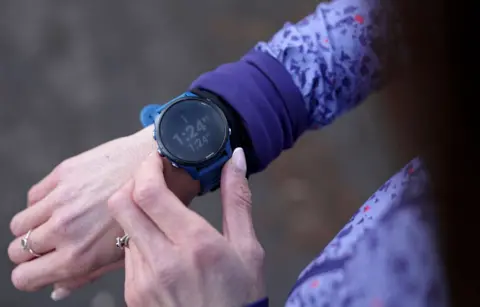
During the scramble, it's hard to see a wrist without a wearable on it. And this extends beyond us participants who wear them.
It's a explosive, multi-billion pound sector. Names like Apple Watch dominate, each with an wide selection of different devices to cater to a spectrum of lifestyles. Based on how feature-packed the device you select, price tags can start from a hundred pounds to thousands of pounds.
"I find it infuriating, I'm unable to relax."
"It reassures me… It's like a companion supporting me."
"Stop telling me I've had a restless night."
A small sample of the responses I've had from fellow device users when I question what they think of theirs.
A Sea of Statistics
My current opinion on mine? Right now, irritating. It's reporting my speed is wrong, causing me to question whether the trees I'm passing under are interfering with my satellite signal.
Millions of us strap these small gadgets onto our wrists and keep them on constantly, seemingly at ease with the fact they're constantly tracking us.
A distant memory are the days when we relied on them exclusively to give us an idea of our daily steps. Currently, they can track our nightly rest, blood pressure, oxygen saturation, our body battery.
It's a challenge to find a physical metric they don't track.
But are they able to do what they claim to do? And are the data points we analyse a true reflection of reality? Do they boost our daily wellness, or do the avalanche of measurements and motivational messages just add to our sense of overwhelm?

A Love-Hate Relationship
"I do get a quite preoccupied with mine," one user admits.
While she loves how her device monitors her runs, she finds some of its other features "overwhelming" at times - a feeling initially realised during a major life event.
Until she found out she could put it into a specific mode, her smartwatch repeatedly informed her she was failing to be productive enough. In a new phase, the watch insists her she's had a poor sleep score.
"I have a infant, there's no point to be informed my sleep was poor," she says. "That fact is all too clearly."
Couldn't she just stop wearing it?
"It's possible, theoretically, but I've got this love-hate relationship with it," she explains. "I love it for its exercise data, I just wonder whether all the other things it can now do is possibly overkill for me."
How Do They Work?
Different brands of smartwatch has its own proprietary way of monitoring your bodily functions and analysing your data, but the most use sensors on the reverse of the watch.
They commonly project minute LED lights onto your wrist which can observe capillary action, identifying your pulse rate. Higher-end devices measure changes in the skin conductance that runs through the skin to assess your nervous system activity.
The Professional Viewpoint
A data scientist says that in general for smartwatches, it's a "delicate equilibrium" - while the rapidly advancing tech could potentially save lives, "spotting abnormalities before we feel unwell", it could also turn us the tracked into the "concerned but fine".
He points out that newer wearables can perform tests like medical-grade monitoring, which constantly monitor how stable the heart is. They can flag if someone is experiencing a heart arrhythmia, where there is abnormal impulses in the heart causing an arrhythmia.
This does not mean someone is on the verge of a heart attack, but it can give an advance notice they might be more vulnerable of a blood clot in the future.
But how to understand these figures is complicated. The expert worries that as additional features are added, people may not be able to fully comprehend their data.
"I remain sceptical that having the capacity to monitor so much data is such a positive development," he says.
A health researcher specialising in cardiology concurs. Her work into the effect of wearable tech on a cohort of individuals with health issues suggested a significant portion of those who were given devices to monitor their condition experienced increased anxiety and were "had a higher tendency to use healthcare resources".
She identified a cycle with her patients - they spotted a concerning reading on their watch. They became worried. Their BPM went up. They got increasingly anxious. They checked again, and their heart rate increased again.
"If we see data about ourselves that we can't properly interpret then, understandably, we are going to become concerned," the psychologist says. "We check, we check again - it becomes a vicious cycle."


